
Squirrel Removal in Chula Vista, CA
Get squirrels out of your attic and keep them out, with entry points sealed properly
- Attic & roofline
- Humane removal
- Entries sealed properly
Book your free inspection
- Fast, courteous service
- Clear, upfront pricing
We are answering the South Bay line now.




Roofline Specialists
Squirrel work is a building problem as much as an animal one. We seal entries with gnaw-resistant materials, not caulk and foam.
Attic Inspections
We check for nesting and young before anything is closed up, so no animal is ever sealed inside a wall or ceiling cavity.
Cleanup Included
Soiled insulation and nesting material are removed and treated, because the odour left behind attracts the next squirrel.
Squirrel Removal for Chula Vista Homes and Attics
A squirrel in the attic is not the same problem as a mouse in the pantry. Tree squirrels are large, powerful chewers that work in daylight, return to the same nest year after year, and can open a gap in a roofline wide enough to invite everything else in behind them. By the time most Chula Vista homeowners call us, the animal has already been overhead for weeks and the damage is in the insulation, the soffit, or the wiring.
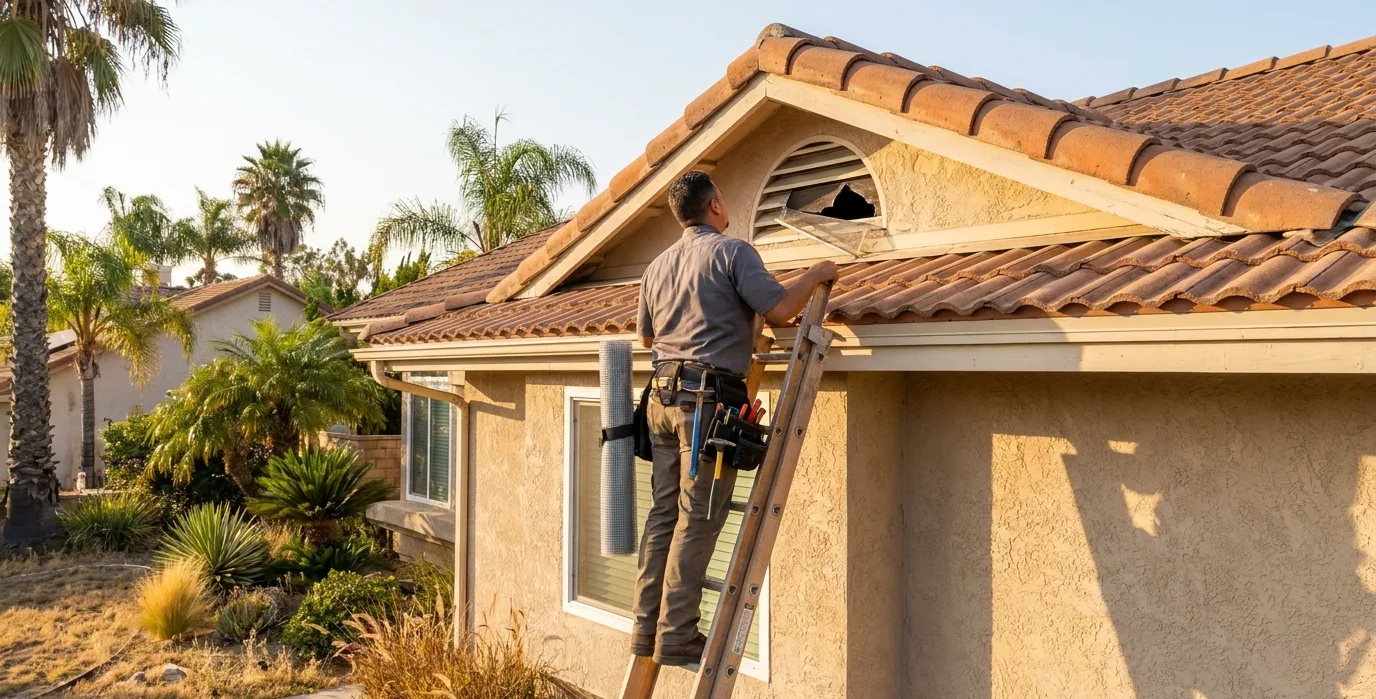
We handle squirrel work as a building problem as much as an animal problem. Getting the squirrel out matters, but it only holds if the way it got in is closed properly and the roofline is left in a condition the next squirrel cannot exploit. That is the part homeowners most often tell us was missing from previous attempts.
Why Chula Vista Property Owners Have a Squirrel Problem at All
Our neighborhoods sit against canyon edges, mature eucalyptus and palm stands, and long stretches of established street trees — exactly the habitat fox squirrels and ground squirrels prefer. Older parts of Castle Park and Montgomery have wood-framed eaves and open rafter tails that give a determined animal an obvious entry. Newer construction in Otay Ranch and Eastlake tends to be tighter, but attic vents, gable louvers and the gap where a roof plane meets a wall are still weak points.
Our climate compounds it. Without a hard winter, squirrels here do not face the seasonal die-off that limits populations elsewhere, and they can produce more than one litter a year. A female looking for somewhere dry and defensible to raise young will treat your attic as a superior version of a tree hollow, and she will fight to keep it.
Our Squirrel Removal Process
Every property is different, but the sequence below is what a thorough job looks like. Skipping any one of these steps is usually why a squirrel problem comes back.
Inspection of the Roofline and Attic
We start outside, working the full perimeter of the roof: eaves, fascia, soffit returns, vent screens, chimney chase, and any point where two roof planes meet. Squirrel entries are often smaller than people expect and frequently show a smooth, stained rub mark where the animal passes through repeatedly.
Locating Active Entry Points
We distinguish between holes currently in use and old damage. That matters, because sealing an active entry with an animal still inside creates a far worse problem — a trapped squirrel will chew its way out through drywall or wiring, and if it cannot, you are left with an odour problem inside a wall cavity.
Checking for Nesting and Young
Before anything is closed up, we check whether there is a nest and whether there are dependent young. Handling that correctly is the difference between a clean resolution and a situation nobody wants. It also affects timing, and we will tell you plainly if the right thing to do is wait a short period rather than act immediately.
Humane Removal
Depending on the layout we use one-way exclusion devices that let a squirrel leave and prevent it from returning, or live trapping where exclusion is not practical. Traps are placed where the animal actually travels, checked on a schedule, and never left to sit.
We work within California's wildlife regulations, which are stricter than many homeowners realise — the state limits what may be done with trapped tree squirrels, and relocating them to a park or canyon is not the simple, humane-sounding option it appears to be. We will explain exactly what the lawful options are for your situation before we begin, rather than after.
Sealing and Exclusion
This is the step that determines whether the work lasts. Squirrel-proofing is not caulk and expanding foam; a squirrel will remove both in an afternoon. Entry points are closed with materials chosen to resist gnawing — heavy-gauge metal mesh, sheet metal flashing, hardware cloth behind vent louvers — and fitted so there is no edge to get a tooth under.
Trimming Back the Approach
Because closing a roof void at the wrong time of year seals a litter inside it, Rodent Control Chula Vista checks for dependent young before any attic is shut up.
Squirrels reach most roofs by jumping from a branch. Where overhanging limbs give easy access we will point out what needs cutting back and roughly how far, so you can have it trimmed and remove the highway rather than just the doorway.
Cleaning Up What Was Left Behind
Nesting material, droppings and urine-soaked insulation do not simply stop mattering once the animal is gone. They hold odour that signals the space is a suitable den site to the next squirrel, and soiled insulation loses much of its value. We remove contaminated material, treat the area, and tell you honestly whether the insulation needs replacing or is fine to leave.
Damage Squirrels Cause — and What It Costs to Ignore
Chewed Electrical Wiring
This is the risk that should concern you most. Squirrel incisors grow continuously and the animals gnaw to manage them; wire insulation is a convenient surface. Exposed conductors in an attic full of dry nesting material is a genuine fire hazard, and it is the reason we treat attic squirrel activity as urgent rather than routine.
Compromised Insulation
Squirrels flatten insulation into runways and foul it as they go. The practical result is a hotter upstairs in August, a harder-working air conditioner, and a utility bill that creeps up for reasons that are not obvious from inside the house.
Structural and Roof Damage
An entry hole is also a water entry point. Once fascia, soffit or roof sheathing is opened up, winter rain gets into framing that was never meant to be wet, and a modest animal problem turns into a carpentry and dry-rot problem.
Noise and Disruption
Squirrels are active at dawn and again in the late afternoon, and the sound of an animal rolling nuts across ceiling joists above a bedroom is not something most households tolerate for long. It is also the most common reason people first call.
What the Nest Attracts Next
A nest left in place after the animals are gone becomes a reservoir for both. An open entry point also gives rats, mice and roof rats an established route into the same space.
Signs You Need Professional Squirrel Removal
Scratching or Rolling Sounds Overhead
Heavy scurrying in the early morning, particularly a rolling or dragging noise, points to squirrels rather than rodents. Rats tend to be active after dark; squirrels keep daylight hours, and that timing is one of the more reliable ways to tell them apart.
A Visible Hole at the Roofline
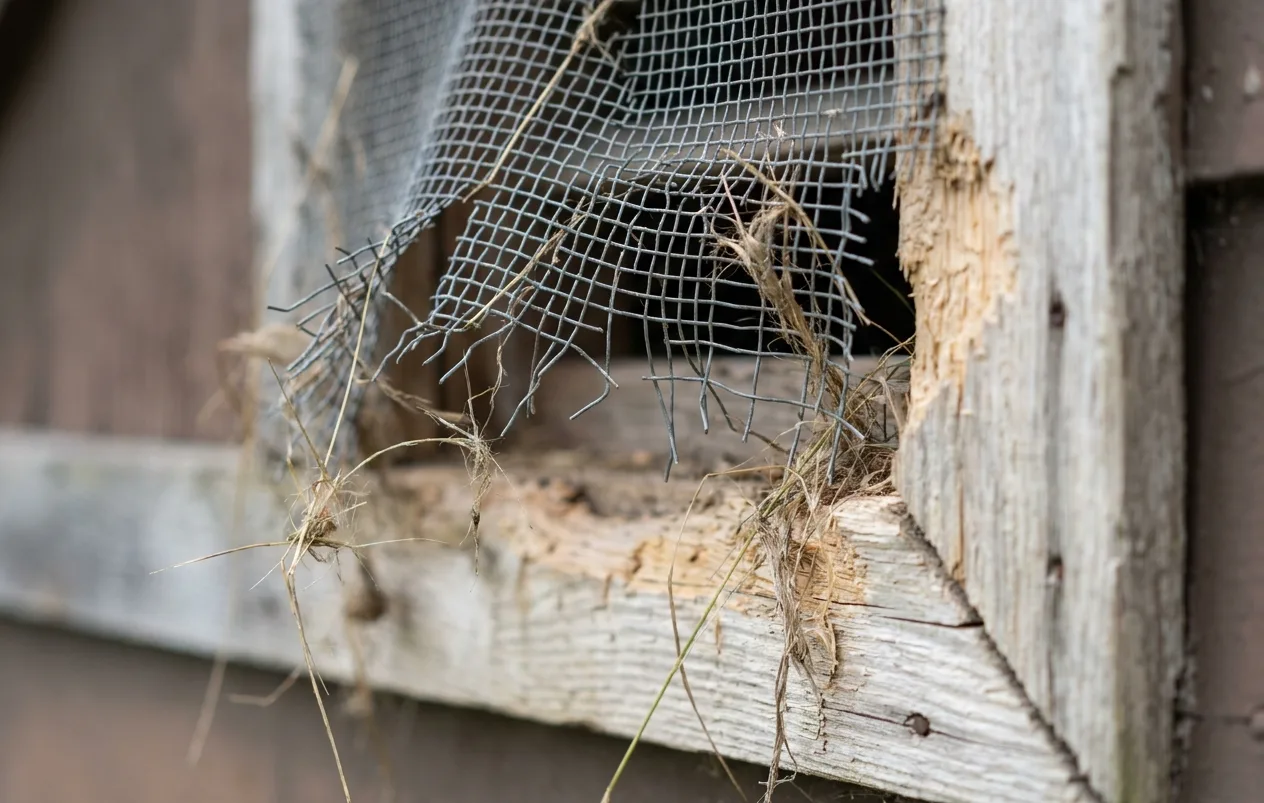
Look at your eaves and gable vents from the ground with binoculars. A torn vent screen, a lifted shingle edge, or a round opening at a soffit corner is worth investigating before the rain arrives.
Nesting Material in Gutters or on the Ground
Shredded bark, palm fibre, insulation fragments or leaf litter appearing below an eave usually means material is being carried in above.
Gnaw Marks on Wood, Trim or Wiring
Fresh gnawing shows pale, clean wood against weathered surrounding timber. On wiring it looks like stripped or scored insulation, and it warrants attention immediately rather than at your convenience.
Daytime Activity on the Roof
A squirrel repeatedly running the same route along a fence, up a downspout and onto the roof is not passing through. That is a commute, and it usually ends somewhere.
Keeping Squirrels Out for Good
Once the animal is out and the entries are sealed, a few things keep the problem from repeating. Keep branches cut well back from the roofline. Screen attic and gable vents with metal mesh rather than plastic or fibreglass. Secure bird feeders or move them away from the house, since a feeder is effectively an invitation. Keep fruit picked up off the ground, and check the roofline once a year — ideally before the rainy season — for anything that has opened up.
If you are hearing something overhead and are not sure what it is, that is a reasonable moment to call. We would rather look and tell you it is nothing than be called back in six months to deal with the wiring.
★ FAQ
Frequently Asked Questions
They are, which is why they are the one non-rat, non-mouse animal we handle. The work is the same trade — find the entry, remove the animal, close the building in metal.
It is the usual problem. Squirrels gnaw to keep their incisors down and cable sheathing is convenient material, so an attic population and chewed wiring tend to arrive together. Where we find it we photograph it and tell you to get an electrician.
There are legal and practical limits to relocation, and an animal released nearby frequently returns or simply becomes somebody else's problem. We will set out what is actually permitted rather than promise an outcome that is not.
Higher up than rats, usually — a gable vent with a failed screen, a gap at a roofline junction, or a branch that gives access to the roof in the first place. The tree is often as much a part of the fix as the building.
📍 On the map
How We Handle a Squirrel in the Attic
Inspect, remove humanely, seal properly, clean up
We work the roofline first to find every active entry, confirm whether there is a nest or dependent young, then use one-way exclusion or live trapping depending on the layout. Entries are sealed only once the space is clear, and contaminated insulation is removed rather than left to signal the site to the next animal.